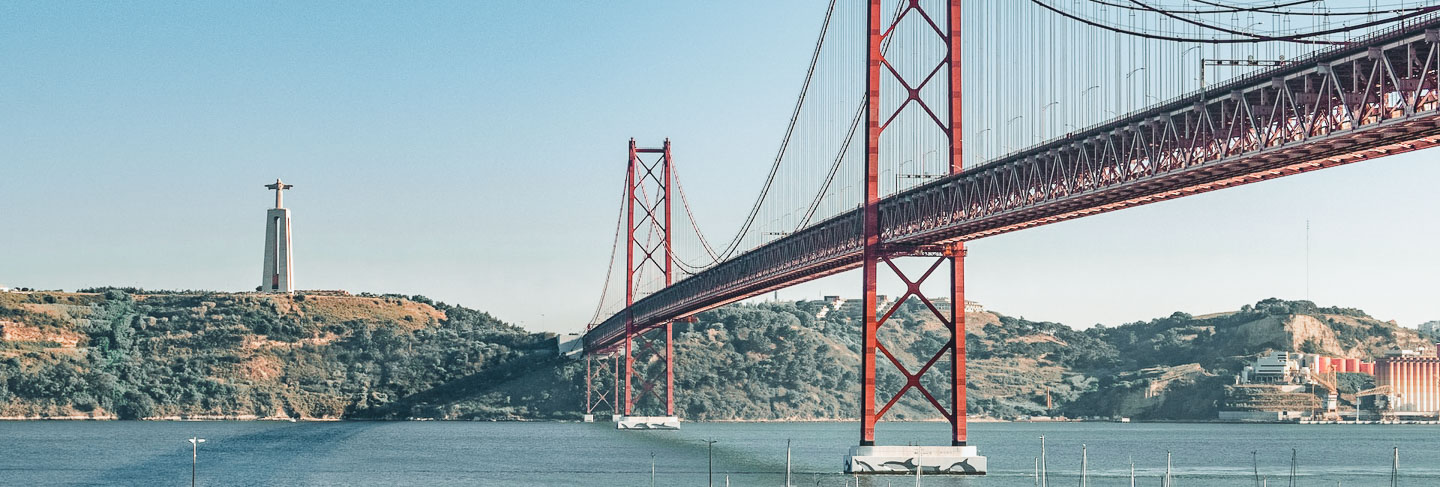
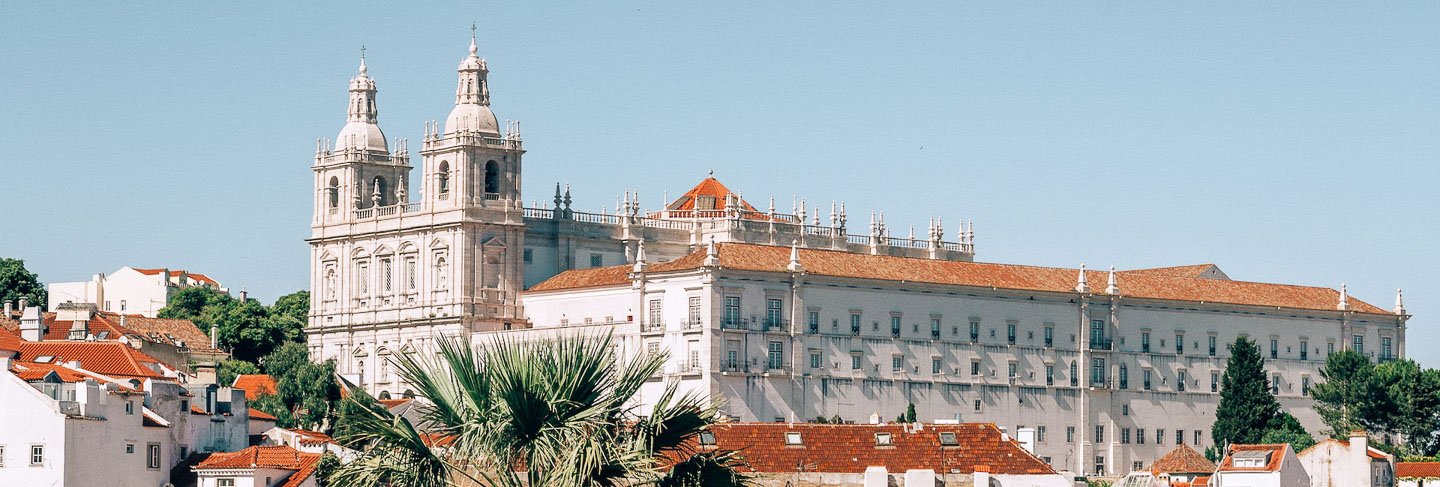
Lisbon is said to have been founded around 1200 BC by the Phoenicians, a seafaring people, who sought its favourable position on the banks of the Tagus. Legend has it that it was founded by Ulysses, who was seduced by the ruler of these, an enigmatic-looking queen, who was half-woman and half-serpent. In order to build a city in this region, Ulysses accepted the queen's terms, namely to stay there forever. Realising his mistake and overcome by the desire to set sail again in search of new adventures, he deceived her and fled. Betrayed, the queen tried in vain to reach the sea, but died in the process.
Legend has it that the seven hills of Lisbon were created by the curling of the queen's tail as she tried to catch Ulysses.
In 205 BC, Lisbon came under Roman rule, taking the name Felicitas Julia, in honour of Julius Caesar. It was later invaded by the barbarians and then the Moors. The latter renamed it al-ʾIšbūnah in 719, imposing a new language and a new religion. During the four centuries of Arab rule, Lisbon prospered and traces of this period can be seen today in the ornamental tile walls that adorn the streets and buildings, in some of the azulejos and in various Portuguese words. After the Reconquista by Alfonso Henriques, the first king of Portugal, supported by a fleet of crusaders, Lisbon became the capital of the Kingdom of Portugal in 1255.
The Era dos descobrimentos, between the 1400s and the mid-1500s, is undoubtedly the golden period in Portuguese history: Lisbon became a commercial and maritime power, as well as a colonial power throughout the world. It should be remembered that before the 'discovery' of America by Christopher Columbus, Bartolomeo Diaz had reached the Cape of Good Hope. Later, Vasco da Gama became the first European to reach India and develop a trade on the spice route.
The first use of the term saudades, emblematic of Portuguese sentiment, dates back to this time, often translated as nostalgia or melancholy. It is closely linked to the history of a people who have always felt deeply their relationship with the sea and the sadness of those who leave, the nostalgia for their land and their loved ones.
At the height of its power, in spite of Spanish rule for some sixty years, Lisbon was devastated by a terrible earthquake on the morning of 1 November 1755, while many worshippers were attending mass. The city was literally leveled by an earthquake measuring 9 on the Richter scale, causing tsunamis and fires, and killing between 30,000 and 40,000 people.
It was a humanitarian and economic disaster, from which the city gradually recovered, thanks to the leadership of the prime minister of the time, the Marquis of Pombal. This enlightened statesman, having also demolished the last vestiges of the pre-existing medieval city, decided to rebuild Lisbon according to a decidedly more modern urban plan, in line with the neoclassical style of the time, which is still very much in the style of a great capital.
In the 19th century, Portugal was conquered by Napoleone' s troops before coming under English rule. Portugal remained a constitutional monarchy until the revolts that led to the establishment of a republic in 1910. However, this newly formed republic was unstable, with successive governments and the outbreak of a civil war. This instability helped Commander Antonio de Oliveira Salazar to come to power in 1926, who established a fascist regime until 1974, when the famous Carnation Revolution (Revolução dos Cravos) marked the beginning of democracy.
The dictatorship weakened the country economically and socially, but upon joining the European Community in 1986, it gradually recovered and implemented reforms. The history of Lisbon, like that of Portugal, is that of a people who have withstood environmental disasters and foreign domination; nation that has fallen but is rising ever stronger, with a multicultural soul and a heart that beats to the rhythm of regional traditions that, even in the face of modernisation, remain intact.
When you travel to Portugal, you will immediately be struck by the welcoming atmosphere provided by the music, which is an important part of the Portuguese culture. The Alfama and Bairro Alto districts in Lisbon are particularly famous for their fado, a traditional Portuguese music.
The Portuguese love to meet up to play football. You will often find the Portuguese in a bar or café, sharing their joie de vivre in front of a football match. It is also an excellent opportunity to mingle with this vibrant people.
But Portuguese culture also sparkles through its wealth of religious monuments. With its Catholic heritage, Portugal has a rich religious patrimony, such as the gigantic cathedral of Coimbra and the monastery of the Hieronymites. The monastery of Batalha, with its incredible beauty, is also well worth a visit.
Portugal's culture and traditions are further revealed through its gastronomy, which you can savour in one of its traditional restaurants and tapas bars. Try the pasteis de Belém or the famous pasteis de nata.